Introduction
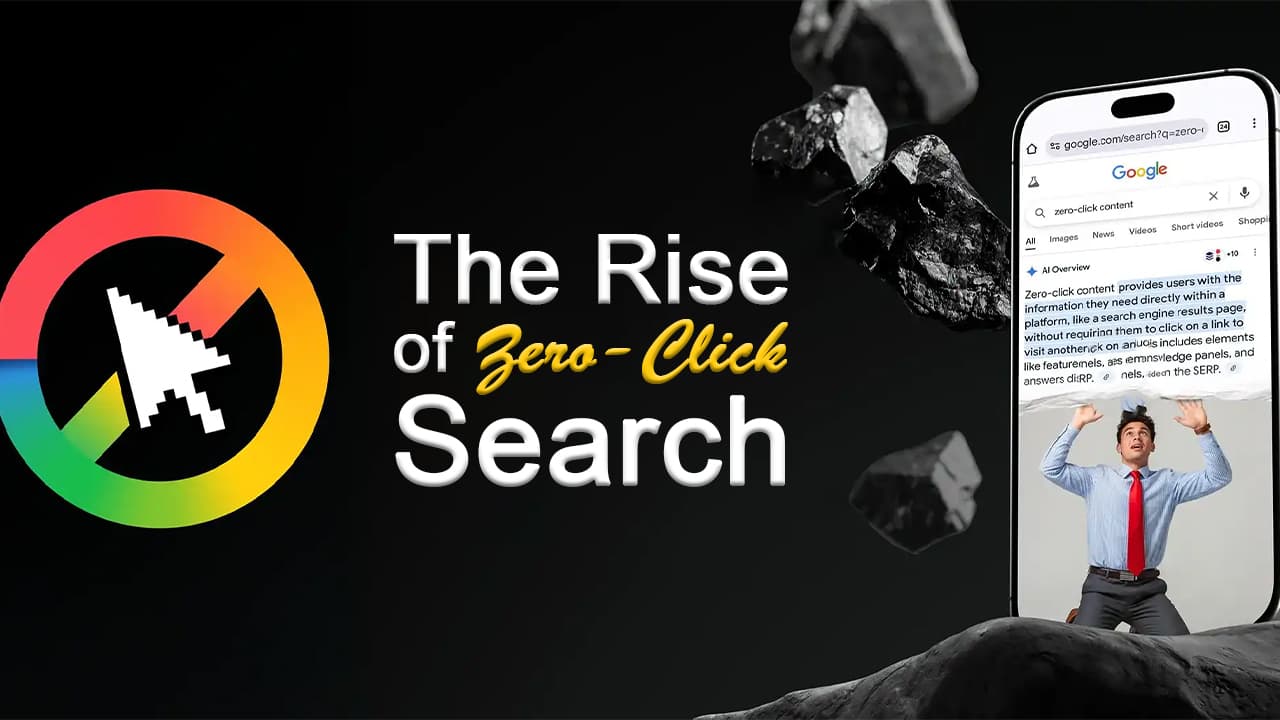
The digital marketing landscape is experiencing a seismic shift that's catching many businesses off guard. For years, the formula was straight forward: create quality content, optimize for search engines, achieve strong rankings, and enjoy the resulting website traffic. But recently, something has changed. Businesses with excellent search rankings are watching their organic traffic decline, and the reason has little to do with their SEO strategy. The culprit is zero-click search—a phenomenon where users get their answers directly on search results pages without ever clicking through to websites.
This isn't a minor trend. More than half of all Google searches now end without
a single click to an external website. For businesses that have built their digital presence around capturing organic search traffic, this represents a fundamental challenge to their entire approach. Understanding zero-click search and adapting to it isn't optional—it's essential for survival in today's digital
ecosystem.
What Is Zero-Click Search?
Zero-click search occurs when search engines provide answers directly on the results page, eliminating the need for users to visit websites. Consider your own search behaviour: when you Google "weather forecast," "currency conversion," or "capital of France," you get immediate answers without clicking anywhere. That's zero-click search in action.
These instant answers appear in multiple formats. Featured snippets extract text from web pages and display it prominently at the top of results. Knowledge panels show comprehensive information about entities like businesses, people, or places. Local packs display map-based business listings with contact details and reviews. Additional formats include calculators, sports scores, stock prices, flight information, and increasingly, AI-generated summaries synthesizing
multiple sources.
The numbers are striking. Recent studies show that over 50% of Google searches result in zero clicks to external websites, with some categories like informational queries seeing even higher rates. This marks a dramatic shift from just a few years ago when clicking through to websites was standard user behaviour.
The Driving Forces Behind Zero-Click Search
This evolution reflects search engines transforming from directories pointing to information into answer engines providing information directly. Several factors are accelerating this change.
User expectations have evolved dramatically. Modern searchers want instant gratification, not homework. When someone asks their phone a question, they expect an immediate answer, not a list of websites to explore. Search engines meeting this expectation build loyalty and increase engagement, making zero-click results a competitive advantage.
Mobile usage has made clicks more costly With smartphones now dominating search volume, the friction of clicking through to websites has intensified. Each click means waiting for pages to load, dismissing cookie banners, navigating unfamiliar interfaces, and consuming mobile data. Zero-click results bypass these frustrations entirely, making them especially valuable for mobile users.
Competitive pressure from AI assistants like Chat-GPT, voice assistants, and other platforms forces traditional search engines to prove their value. Providing comprehensive direct answers helps them maintain relevance and market dominance in an increasingly crowded field.
Vast data availability enables search engines to extract and synthesize information from across the web. With structured data from millions of websites at their disposal, combined with advancing AI capabilities, they can provide sophisticated answers without sending users elsewhere.
What This Means for Business Websites
The implications of zero-click search are complex and multifaceted, creating both challenges and unexpected opportunities.
Traffic volumes are declining for many websites, particularly for informational content. Even businesses maintaining strong search rankings see reduced click-through rates. A position that once drove hundreds of daily visitors might now generate only dozens. For publishers relying on advertising revenue and businesses depending on content marketing for lead generation, this creates significant pressure.
Traffic quality is paradoxically improving. While overall numbers drop, visitors who do click through tend to be more qualified prospects. They've moved past basic information gathering and are seeking detailed content, specific solutions, or ready to engage with services. These higher-intent visitors often convert at substantially better rates than casual information seekers.
Brand visibility retains significant value even without clicks. Appearing in featured snippets, knowledge panels, and other prominent search features provides exposure and builds brand recognition. Users see your name associated with authoritative answers, creating mental availability that influences future decisions even if they don't visit immediately.
Success metrics require recalibration. Raw traffic numbers and click-through rates, while still relevant, no longer capture the full picture. Impressions, brand search volume, engagement depth, and actual conversion rates become more meaningful indicators of search performance and business impact.
Competitive dynamics are shifting. Companies that quickly adapt to zero-click realities can gain advantages over competitors still optimizing purely for traffic volume. Those focusing on brand strength and conversion quality may outperform those chasing vanity metrics.
Adapting Your Digital Strategy
Successful businesses aren't resisting zero-click search—they're evolving their strategies to align with it.
Optimize strategically for featured snippets. Structure content to answer questions clearly and concisely. Use descriptive headers, create FAQ sections, and format information in easily extractable ways. While this might seem counterintuitive—giving away answers that previously required clicks—the authority and visibility gained often outweigh the traffic trade-off.
Invest heavily in brand building. In a zero-click world, brand recognition becomes exponentially more valuable. When users repeatedly see your brand in search results, you build familiarity and trust. Invest in thought leadership, social media engagement, partnerships, and consistent messaging that reinforces your identity. When users eventually need deeper engagement, strong brands win.
Target bottom-of-funnel keywords more aggressively. Informational queries are most susceptible to zero-click results. Commercial and transactional keywords still generate clicks because users need detailed information before making decisions. Shift more content strategy toward purchase-intent keywords and service-focused content that naturally requires website visits.
Create content that can't be summarized. Develop resources that simple cannot fit in a snippet: interactive tools, calculators, original research, comprehensive guides, detailed case studies, and unique perspectives. Give users compelling reasons to click through by offering irreplaceable value.
Implement comprehensive structured data. Schema mark-up helps search engines understand and accurately display your content. This technical investment increases your chances of appearing in rich results and ensures professional, authoritative presentation when you do appear.
Diversify traffic sources aggressively. Over-reliance on organic search has become increasingly risky. Build robust email lists, create engaged social communities, establish strategic partnerships, invest in paid channels, and develop direct traffic. Multiple sources create resilience against algorithm changes.
Embrace emerging search formats. Optimize for voice search, which heavily uses featured snippets. Ensure visual search can discover your images and products. Consider performance across different devices, platforms, and search modalities. The future is multi-format and multi-platform.
The Hidden Opportunities
Despite challenges, zero-click search creates genuine opportunities for adaptable businesses. Market disruptions always create winners—adaptability determines who thrives.
Zero-click results create new customer journey touchpoints that accumulate value over time. A user encountering your brand in a featured snippet today might research options tomorrow and choose you next week, partly due to
that initial credible exposure. These micro-interactions build brand equity even
without immediate traffic.
As search engines grow more sophisticated with AI, they're improving at understanding genuine user intent. This benefits businesses that truly understand audiences and create content addressing real needs rather than manipulating algorithms. Quality and relevance increasingly trump shortcuts and manipulation.
The businesses struggling most cling to outdated models where success
meant maximizing traffic and hoping for conversions. The businesses thriving view their website as a conversion and relationship hub rather than merely a traffic destination. They're building for quality engagement, not just volume.
Conclusion
Zero-click search represents a permanent evolution in how people discover information online, not a temporary disruption. The businesses that will thrive are those embracing this reality and adapting accordingly. Your website's role
is transforming from being the destination for every query to being the hub for meaningful engagement with qualified prospects. This shift raises the bar for quality—in a world where basic information is instantly available, you must offer substantial value to earn clicks. The path forward requires optimizing for visibility without clicks, building brand strength, creating genuinely valuable content, and diversifying traffic sources. The question isn't whether to adapt, but how quickly you'll embrace this new paradigm and turn it to your competitive advantage.