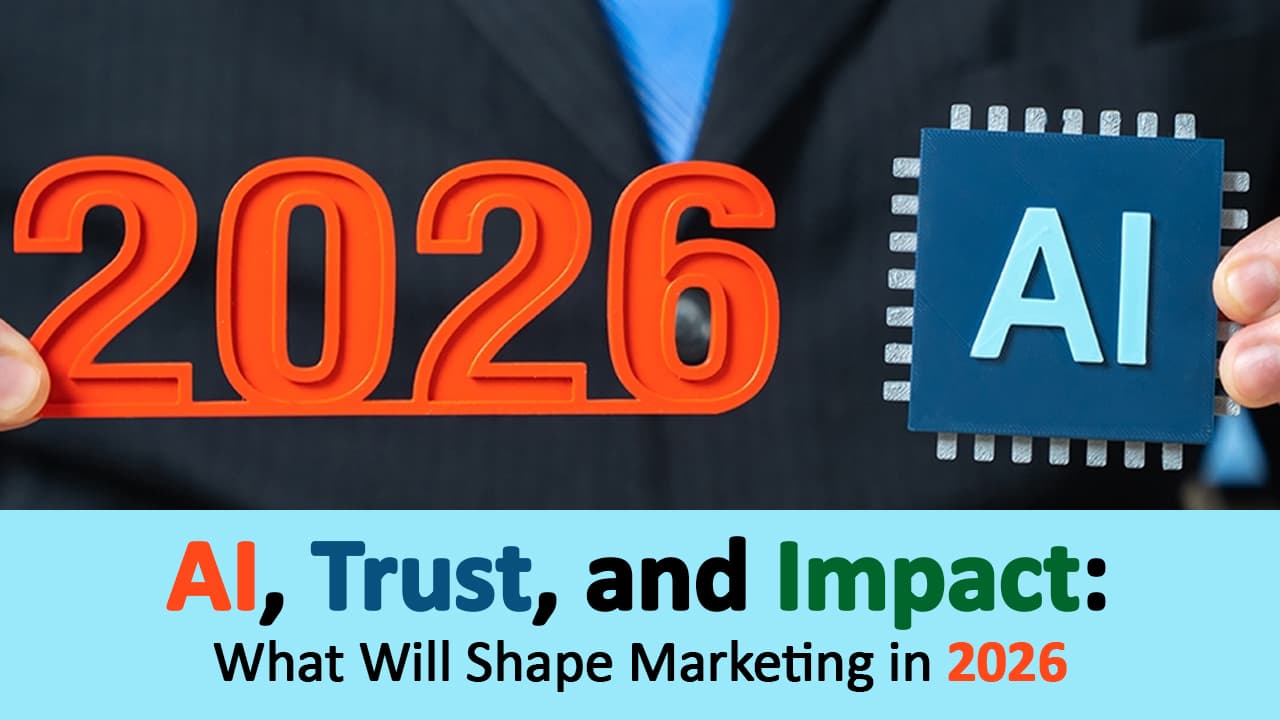
Marketing stands at a crossroads. As we move through 2026, three powerful forces are converging to reshape how brands connect with consumers: artificial intelligence is evolving from a buzzword into an operational reality, consumer trust has fallen to historic lows, and performance pressure is forcing marketers to justify every decision with data. These aren't isolated trends but interconnected dynamics that will define success or failure in the years ahead. The marketers who thrive won't be those who master just one of these dimensions, but those who understand how AI capabilities, authentic credibility, and measurable impact must work in concert. This year represents a pivot point where old playbooks become obsolete and new strategies emerge from the intersection of technology, transparency, and tangible results.
AI becomes the engine of a new marketing era
Artificial intelligence has moved beyond experimental pilots into the core infrastructure of modern marketing. Machine learning algorithms now predict customer behavior with uncanny accuracy, generative AI produces personalized content at scale, and automated systems optimize campaigns in real-time across dozens of channels simultaneously. What once required teams of analysts and weeks of planning now happens in milliseconds. AI-powered recommendation engines drive significant portions of e-commerce revenue, chatbots handle millions of customer interactions, and predictive analytics identify high-value prospects before they even know they're in the market.
Why this creates a new challenge for marketers
The democratization of AI technology means competitive advantage no longer comes from simply having these tools. Every brand now has access to sophisticated AI platforms, creating a new arms race where differentiation requires strategic thinking rather than technological access. Marketers face the challenge of using AI to enhance human creativity rather than replace it, of leveraging automation while maintaining authentic brand voice, and of scaling personalization without sacrificing the genuine connections that drive loyalty. The question isn't whether to use AI, but how to use it in ways that feel helpful rather than intrusive, intelligent rather than mechanical.
Designing AI-powered shopping experiences for the next generation of commerce
Forward-thinking brands are reimagining the entire customer journey through an AI lens. Visual search allows consumers to snap a photo and instantly find similar products. Conversational commerce platforms let shoppers describe what they need in natural language and receive curated recommendations. Augmented reality powered by AI enables virtual try-ons that account for individual body types and preferences. These experiences go beyond convenience to create entirely new ways of discovering and evaluating products. The next generation of commerce isn't just faster or more efficient, it's fundamentally different in how it connects consumer intent with brand offerings.
How brands are navigating this new era of AI-driven marketing
Leading marketers are adopting a balanced approach that combines AI's analytical power with human judgment and creativity. They use machine learning to identify patterns and opportunities, but rely on human strategists to interpret insights within broader cultural and business contexts. They deploy generative AI to create content variations, but ensure creative directors maintain brand integrity and emotional resonance. They implement automation to handle repetitive tasks, but preserve human oversight for decisions that carry reputational risk. This hybrid model recognizes that AI amplifies human capabilities rather than replacing them, and that the most effective marketing combines computational precision with creative intuition.
Declining trust redefines what makes marketing credible
Consumer trust in brands, institutions, and media has eroded dramatically. Misinformation, data breaches, influencer scandals, and corporate controversies have made audiences increasingly skeptical of marketing messages. Traditional advertising faces declining effectiveness as consumers tune out obvious promotional content and rely instead on peer reviews, independent creators, and their own research. This trust deficit isn't just a perception problem but a fundamental shift in how people evaluate information and make decisions. Brands can no longer assume their messages will be believed simply because they're communicated through paid channels.
Why this creates a new challenge for marketers
In a low-trust environment, every marketing claim faces scrutiny and every interaction either builds or erodes credibility. Marketers must earn attention and belief rather than purchasing it, prove rather than assert, and demonstrate value through actions rather than promises. This requires transparency about product limitations, honesty about business practices, and consistency between what brands say and what they do. The challenge extends beyond messaging to encompass the entire customer experience, because consumers now treat every touchpoint as evidence of whether a brand deserves their trust.
How brands are navigating rising skepticism
Successful brands are meeting skepticism with radical transparency and authentic storytelling. They share behind-the-scenes content that humanizes their operations, acknowledge mistakes openly and explain how they're being corrected, and provide detailed information about sourcing, manufacturing, and business practices. They partner with credible third-party validators rather than relying solely on self-promotion, encourage genuine customer reviews even when they're critical, and engage in two-way conversations that treat consumers as intelligent participants rather than passive audiences. These approaches recognize that trust must be earned through consistent behavior over time, not manufactured through clever messaging.
Performance pressure is redefining how marketing decisions get made
Economic uncertainty and tightening budgets have intensified demands for marketing accountability. Chief Marketing Officers face constant pressure to demonstrate ROI, prove that every dollar spent generates measurable returns, and connect marketing activities directly to business outcomes. The days of large brand-building budgets without clear performance metrics are fading. Instead, marketers must balance short-term conversion goals with long-term brand equity, justify investments with data-driven projections, and pivot quickly when campaigns underperform.
Why this creates a new challenge
The obsession with immediate measurability can undermine activities that build long-term value. Brand awareness, emotional connection, and category leadership deliver enormous returns but often resist simple attribution models. Marketers face the challenge of defending investments in brand-building while meeting quarterly performance targets, of balancing experimentation with proven tactics, and of demonstrating strategic thinking in an environment that rewards tactical execution. This tension between short-term metrics and long-term growth creates difficult tradeoffs that require sophisticated judgment.
How expectations for decision-making are shifting
Modern marketers increasingly rely on advanced analytics and AI-driven insights to guide strategy. Multi-touch attribution models attempt to credit every interaction along the customer journey, predictive analytics forecast campaign performance before launch, and real-time dashboards enable rapid optimization. Decision-making has become more data-driven but also more complex, as marketers must interpret vast amounts of information and distinguish signal from noise. The most effective leaders combine quantitative rigor with qualitative understanding, using data to inform rather than dictate strategy.
Seeing is understanding: how early adopters are using AI to buy
Consumer behavior itself is evolving as AI tools become commonplace. Shoppers use AI-powered comparison engines to evaluate options across dozens of retailers instantly, leverage chatbots to research products and ask detailed questions, and employ AI assistants to manage subscriptions and recurring purchases. Some consumers are even delegating routine buying decisions entirely to AI agents that understand their preferences and optimize for price, quality, and convenience. This shift means marketers must design experiences that work both for human decision-makers and the AI tools that increasingly mediate those decisions.
What this means for marketers in 2026
The convergence of AI capabilities, trust challenges, and performance pressure creates both opportunity and urgency. Marketers who successfully integrate these three dimensions will build sustainable competitive advantages. This means deploying AI strategically to enhance rather than replace human connection, earning trust through transparency and consistent delivery, and demonstrating business impact while investing in long-term brand equity. It requires new skills, different organizational structures, and a willingness to experiment while maintaining accountability. The marketing organizations that thrive will be those that embrace complexity rather than seeking simple solutions, that balance technology with humanity, and that remain relentlessly focused on creating genuine value for customers.
Conclusion: AI, trust, and impact must work together
Success in 2026 and beyond won't come from mastering any single dimension but from orchestrating all three in harmony. AI provides the tools and insights, trust provides the permission and relationship, and demonstrated impact provides the resources and organizational support to continue innovating. Marketers who understand this interconnection and build strategies that honor all three imperatives will navigate this turning point successfully and emerge stronger in the new marketing landscape.